

Bryan Bennett battled an “800-pound gorilla” working for the Challenger brand in the social casino space. That his experience could prove very important as he works to make Betfred USA Sports an important player in the sports betting sector.
The social casino boom of the early 2010s, sparked by Caesars Interactive’s investment in Playtika in 2009, opened up new audiences to the gaming industry and sparked a wave of M&A. DoubleDown, Big Fish Games, Product Madness, Buffalo Studios, and others sell at a hefty multiple.
Smaller challengers tend to vie for market share, and as a result, market leaders have turned to them as acquisition targets to further strengthen their strong positions.
Bryan Bennett was one of those challengers, joining the fray as VP of Marketing for slot developer Rocketplay, which was eventually acquired by slot maker AGS. This led to Bennett, who previously worked for strategy games his developer Kabam and casual his publisher Booyah, turned to his gaming career for real money.
After a stint as an investor and advisor after working in the interactive division of AGS, he joined the wave of sports betting sweeping America. Appointed Chief Operating Officer of Betfred USA Sports 2019.
Fighting an 800-pound gorilla
Sports betting appeals to a very different audience than social casinos and appears to have a more transformative and disruptive impact on the established real money gaming sector. But Bennett points out that the market dynamics of the two industries are very similar.
“Obviously we’re talking about very different user bases, completely different target audiences, and different technologies, but I think in terms of macroeconomic impact, they’re very similar,” he said. I will explain.
“I returned to the position of regularly battling multiple 800-pound gorillas, which is very similar to how the social casino market has played out.”
Just as companies such as DraftKings, FanDuel, BetMGM and Caesars Sports dominated the betting market, companies such as Playtika, Scientific Games and Aristocrat dominated the social market, while companies such as Rocketplay fought to carve out a niche. .
“It’s very similar now,” he continues. “Betfred regularly goes up against some very big companies with big brands and big budgets. We pick our spots and try to do what it takes to be successful. ”
Betfred and the Bengals bared their teeth in Ohio
This means that businesses have to be strategic to seize opportunities and have no desire to aggressively attack every state market as some of their peers have done. increase.
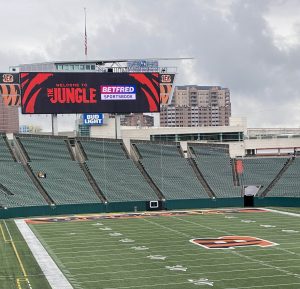
For example, a partnership with the Cincinnati Bengals announced in July provides a point of entry into the Ohio market from 1 January 2023, offering the kind of opportunity Bennett and Betfred have sought. This is the first time Betfred has joined the first wave of launches in the state.
According to Bennett, this means companies will have to fight to secure a foothold in the state with smaller brands and smaller budgets. “In order not to be the first [wave] It’s challenging,” he admits.
“Ohio is the first time I’ve been out with a big brand, one of the biggest brands in the state, and I’m going to be there on January 1st, Universal’s launch date, along with everyone else. We will finally be on a level playing field ready to be completed.”
He says this is a great opportunity for Betfred to grow. “We are going to put a significant portion of our marketing budget in Ohio.
Maryland’s mobile market has plenty of room to grow
Betfred’s growth plans have a lot to do with states preparing universal launch dates. Maryland, which is eagerly awaiting the launch of mobile betting, offers similar opportunities to Ohio.
In Old Rhine, Betfred has partnered with Long Shot’s, a restaurant that offers off-track betting, to give it a physical presence and set it up to secure a mobile sportsbook license.
“We think it’s very likely we’ll be in the first tranche in Maryland as well, and as a result, we’ll put in the marketing budget we need to be successful there,” Bennett adds.
Betfred’s approach is to pick its battles as a small player without the deep pockets of brands vying for supremacy in every state. That doesn’t mean that established markets are off limits. With Caesars preparing to cut spending and companies like Churchill Downs exiting sports betting altogether, businesses change their strategies based on market conditions.
with something like colorado Betfred in Arizona, for example, initially focused on bonuses and has taken a more pragmatic approach. “Frankly, it’s not a recipe for success, so we adjusted some of it,” he says. “If you’re trying to compete on a very transactional basis and trying to steal customers based strictly on bonuses, there’s no loyalty there. They’re just going to flip to the next guy.”
“We have bonus hunters doing it with all different operators. We decided not to play that game. It’s deeper than a $1,000 bet with no money.”
emotional connection
Betfred’s playbook is focused on understanding players and is focused on intermediate and VIP audiences. Betfred is ‘totally useless’ for more casual bettors as they are likely to flip from bonus to bonus.
“Instead, we want to see something move up that tier and be able to serve that frequent player and VIP. We believe that we can compete in the US because we are small, agile, and able to focus on that core target group and serve them better than some of the larger entities.”
This group does not necessarily consist of players focused on sportsbook products. Instead, Bennett sees these customers as those who want a better experience overall. They value strong customer service, ensuring that any issues are resolved quickly, and enjoy an exceptional experience.
This final component is a key element for Betfred. “Many sports sponsorships allow us to offer suites and VIP levels. [like] Meeting and autographing players.
“we [can] Put it to good use and give your VIP players a better experience. And we’ve discovered that there’s something out there that could be Betfred’s business card. “
Of course, these tangible rewards are also easier to sell than customer service, which Bennett points out is pretty much the last thing prospects look for when choosing a sportsbook. is “doesn’t bounce”.
This means that bonuses will continue to play a role as a way to get players to try Betfred. This allows us to analyze an individual’s behavior and develop a personalized level of customer service with a dedicated account manager to develop them into high-value players.
Iowa on the horizon
In a process of constant refinement and adaptation, the business recently migrated its Iowa sportsbook from Sportradar’s Optima to OpenBet, setting it up to match Betfred’s offerings in other states and compete in the marketplace.
This means that we are gearing up to do some marketing en masse in time for the NFL kickoff in September. “I haven’t done much in the past, so I’m looking forward to this football season when I can finally start marketing in Iowa.
“We are doing very well at our Northwestern Iowa casino, but we weren’t competitive in the slightest online. Now we are excited to finally bring it online. ”
Betfred, of course, is built of brick and mortar, and after starting out as a betting shop chain in the UK, has taken it online. But Bennett acknowledges that real success in the United States has to come online.
“We believe in retail,” he says, noting that the location means most of the business comes from Sioux Falls, South Dakota. they are at the casino.
“I think retail can be very successful in certain circumstances, and we want to have that anchor point,” he adds. […] You can do a lot in there place. But clearly we are not simple. We know that true success comes online. “
And after years of dodging £800 gorillas in the social casino sector, Bennett brings some unique experience to Betfred’s push for a position in the market.


