In the latest edition of his column, WaterhouseVC’s Tom Waterhouse looks at the video game sector. Here he points to the potential of a developer focused on live service offerings, including loot boxes, but says it strikes a balance to integrate these features.
Dopamine is responsible for the pleasure that comes from “feel-good” activities such as exercise, music, and indeed gaming. When received, dopamine is released. Casinos know this mechanism works in gambling by hitting jackpots or listening to the sounds of slot he machines.
One of the key questions we ask when considering both gaming and gambling products is, “Is the product exciting for our customers?” Do you have a thrill? In gaming, that thrill could be a big jackpot or a small but frequent reward. You need features that keep players occupied.
change the game
According to a study by the Entertainment Software Association (ESA), there are 3 billion video gamers in the world, and 54% of frequent gamers believe games help them connect with friends.
The first PlayStation was released in 1994 and the first Xbox was released in 2001. Released in 2001, Runescape paved the way for the growth of Massively Multiplayer Online Role Playing Games (MMORPGs), allowing millions of players to connect, chat and compete.
When PC and console games grew in popularity in the 1990s, developers earned all of their revenue from pre-sales of their games, and no additional content was added to the game after its initial creation. The CD normally sold for $40 (£32.70/€38.70) and that was the end of the relationship between player and game developer.
As technology advanced, online stores such as the Xbox Live Marketplace emerged where gamers could complete software updates, purchase additional games, and make in-game purchases.
The combination of technological advancements and the popularity of MMORPGs is driving the proliferation of “live service games.” With live service games, new content is added to games after they’re released, increasing the amount of time players spend and engagement with each game, while significantly increasing revenue per player for game developers. Companies realized in early 2010 that there was a huge revenue opportunity in live service games.
“Before, I would buy a bunch of titles, play them for three weeks, then move on and never watch them again. You need to evolve your business model and realize a little bit that you have a big service component.” – John Riccitiello, former CEO of Electronic Arts (2010).
With live service games like Fortnite and GTA V, the possibilities are endless: new weapons, skins, maps, player outfits, missions, NFTs, and more. We touched on the incredible value of “virtual worlds” in gaming. August 2021 NewsletterFor example, nine years after its launch in 2013, GTA V ( take-two interactive) continues to generate more than $250 million in revenue each quarter.

Electronic Arts (EA): It’s in the game
Founded in 1982, EA is one of the largest digital entertainment companies, providing games, content and services to 580 million active players on console, PC, mobile and tablet. The $36 billion company owns a portfolio of top quality brands including Apex Legends, Battlefield, FIFA, F1, Madden NFL, Need for Speed, Plants vs Zombies, The Sims and more.
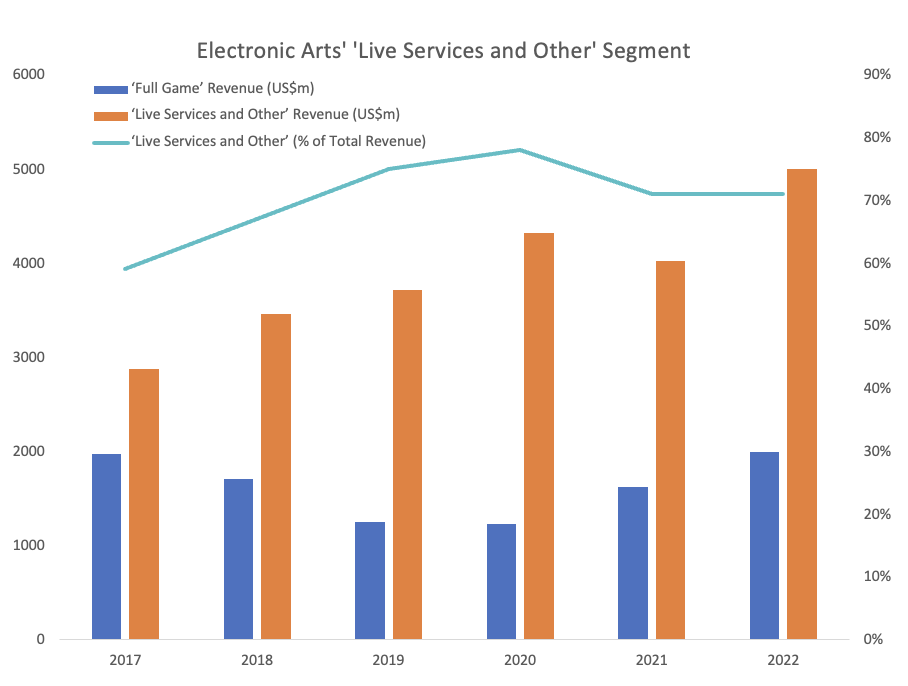
“Live Services and Other” is EA’s fastest growing and largest segment, accounting for 71% of total revenue in FY22, compared to 59% in FY2017. It is primarily driven by FIFA Ultimate Team and Apex Legends.
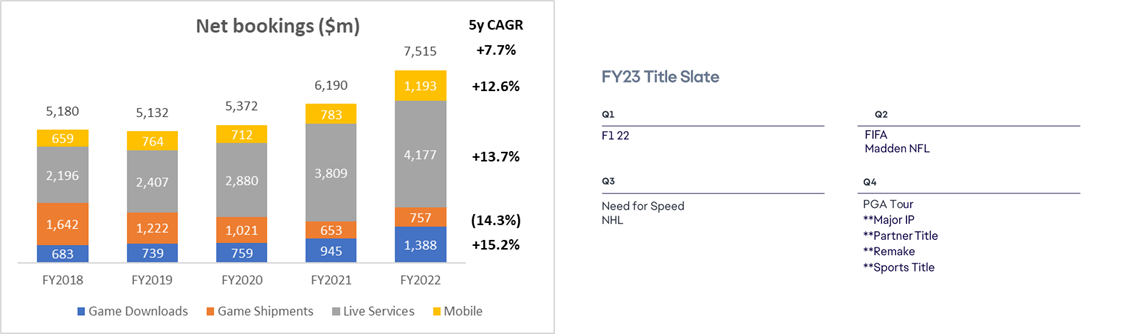
Apex Legends is one of the industry’s top live service games, with over 113 million active players, including 28 million new players who joined in the year ended March 31 of this year. FIFA is the world’s largest and most popular sports video game franchise, with over 325 million copies sold since its launch in 1993. This franchise far surpasses all other popular sports video game franchises.
| franchise | Number of Games Sold (Millions) |
| pro evolution soccer | 111 |
| NBA 2K | 118 |
| Madden NFL | 130 |
| FIFA | 325 |
EA’s Mobile Opportunity
In 2021, EA CEO Andrew Wilson said he expects EA’s mobile business to more than double to $2 billion in annual net bookings by 2024. A free-to-play game.
The live service business model allows consumers to play these games for free and monetize them through in-game purchases. For example, EA developed the FIFA franchise to include FIFA Mobile, a free-to-play mobile product. In the most recent quarter, FIFA Mobile posted its biggest ever quarter in revenue, with unique new players up nearly 80% year-over-year.
A loot box that is an accidental element
Players purchase loot boxes with real money to reveal the contents of in-game “mystery boxes.” These are unknown items that can be used in the game, such as skins, new player features, upgraded weapons, and more.
Loot boxes have been popular since around 2010, but have recently come under particularly intense scrutiny for their gambling-like attributes, given that real money is used to purchase unknown virtual items. In March, EA successfully appealed a fine it faced in the Netherlands over loot boxes in FIFA Ultimate Team. The reason for the decision came down to the court defining FIFA Ultimate Team primarily as a “game of skill” with loot boxes that “add an element of chance”. The main reason for this was that the prizes available were only in-game objects, not products that could be obtained separately from the game.
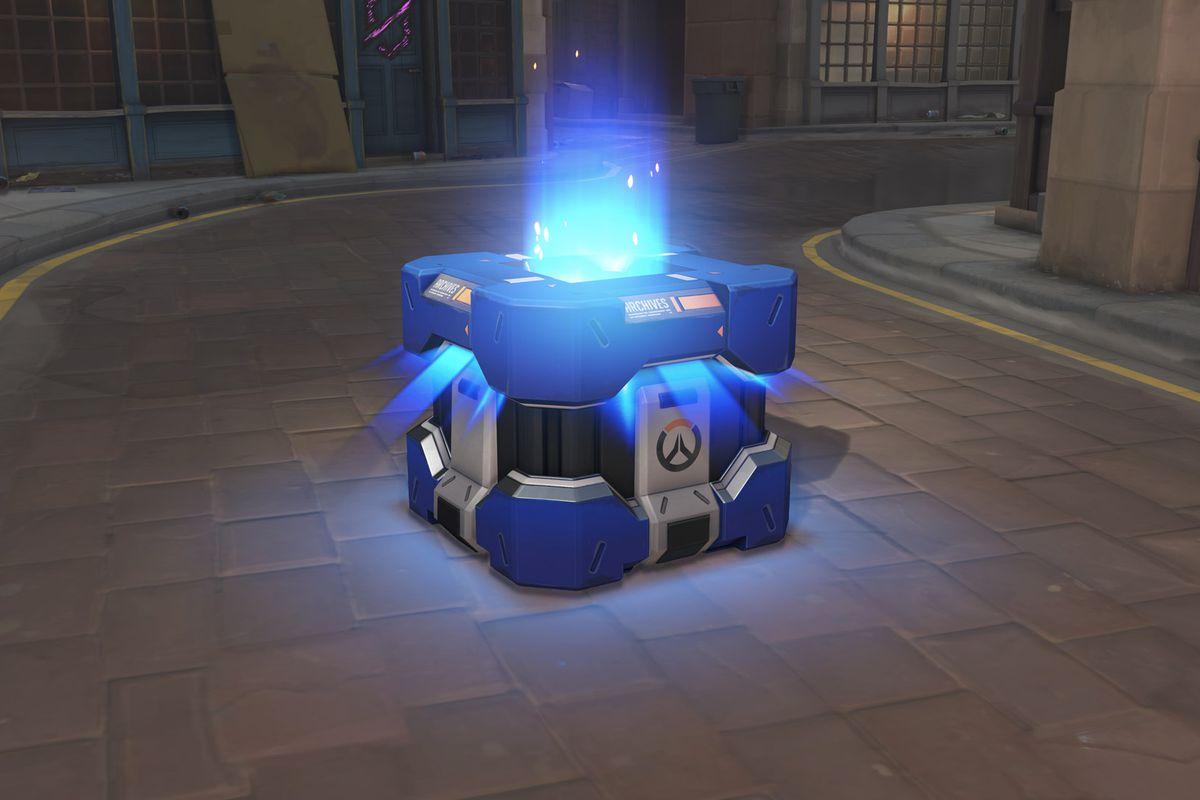
Loot boxes improve the player experience and undoubtedly contribute to the release of dopamine, but video game companies should always ensure that loot boxes are not a central feature of their games. Loot boxes will only become a revenue stream for video game companies if they are ethically and seamlessly integrated.
Evaluation index
EA is highly cash-generating, with operating cash flow of US$1.9 billion in 2022 and funding approximately US$1.5 billion in share repurchases and dividends in 2022. The business is currently valued at 11.4x his EBITDA, with a median EBITDA multiple of 17.4x for peers.
| Company | 5-year EPS CAGR (%pa) | Current EV/EBITDA | Current Free Cash Flow Yield (%) |
| activision blizzard | +11.1 | 17.4 | 3.5 |
| bandai namco | +14.4 | 13.5 | 0.0 |
| Capcom | +30.0 | 19.4 | 4.3 |
| CD Project SA | -4.6 | 22.1 | 0.1 |
| keyword studio | +36.2 | 19.3 | 3.3 |
| Konami Group | +17.7 | 9.8 | 6.8 |
| Nexon | +41.0 | 24.0 | 3.4 |
| Nintendo | +42.9 | 10.5 | 0.0 |
| paradox interactive | +0.5 | 19.1 | 0.6 |
| Square Enix Holdings | +18.1 | 9.4 | 0.0 |
| Take-Two interactive software | +17.4 | 22.8 | 0.6 |
| ubisoft entertainment | +9.8 | 5.3 | 11.7 |
| electronic arts | +12.4 | 11.4 | 4.7 |
| Median | +17.4 | 17.4 | 3.3 |
all the best,
Tom
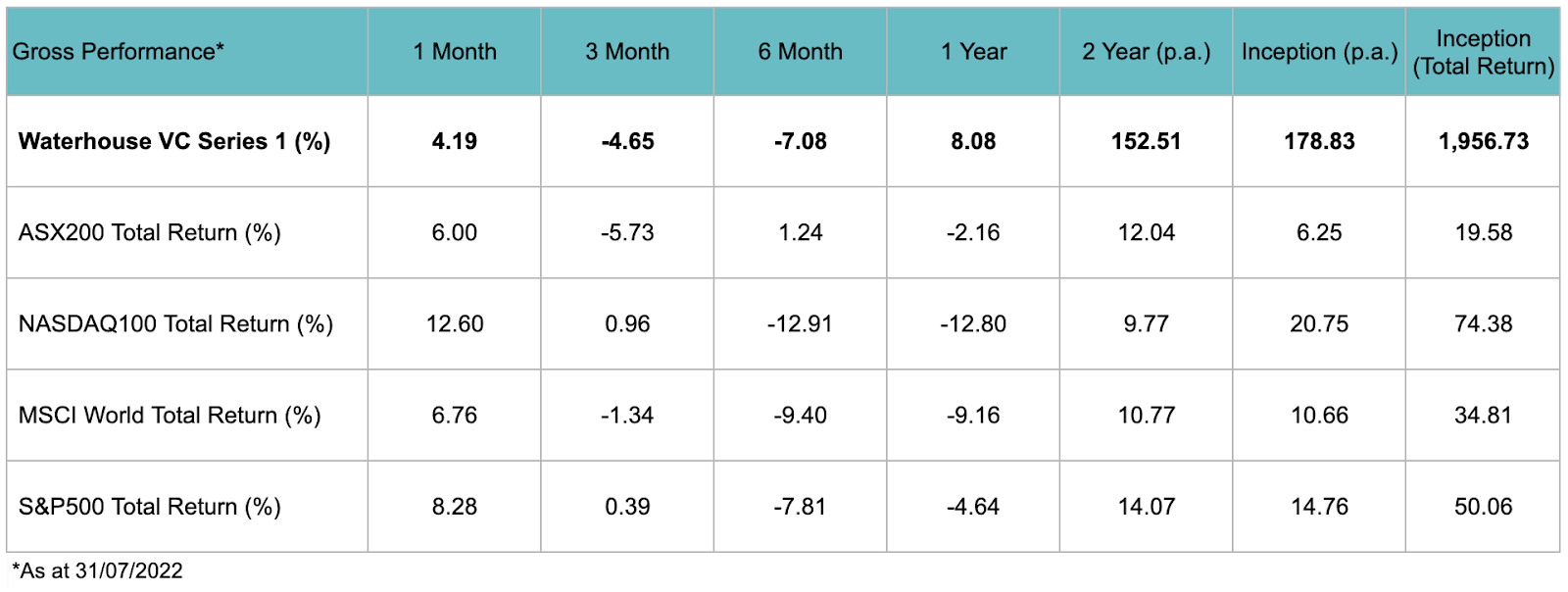
Since its inception in August 2019, Waterhouse VC has achieved a total return of 1,957% as of July 31, 2022, assuming reinvestment of all distributions. See the long-term performance table below.
Please note the above information relating to Activision Blizzard, Bandai Namco, Capcom, CD Projekt SA, Keywords Studios, Konami Group, Nexon, Nintendo, Paradox Interactive, Square Enix Holdings, Take-Two Interactive Software, Ubisoft Entertainment, and Electronic Arts. please. It concerns publicly available information relating to the company and should not be considered or construed as financial product advice. Waterhouse VC has a position in Electronic Arts. The information provided in this document is for general information only and does not constitute investment or other advice. Readers should consult and rely on professional investment advice tailored to their individual circumstances.