Most payment launches don’t fail because of strategy — they fail because of messy integration. MTPAY eliminates delays with structured APIs, production-mirrored sandbox testing, and predictable callback logic that shortens time to market.

Most payment launches don’t fail because of strategy — they fail because of messy integration. MTPAY eliminates delays with structured APIs, production-mirrored sandbox testing, and predictable callback logic that shortens time to market.

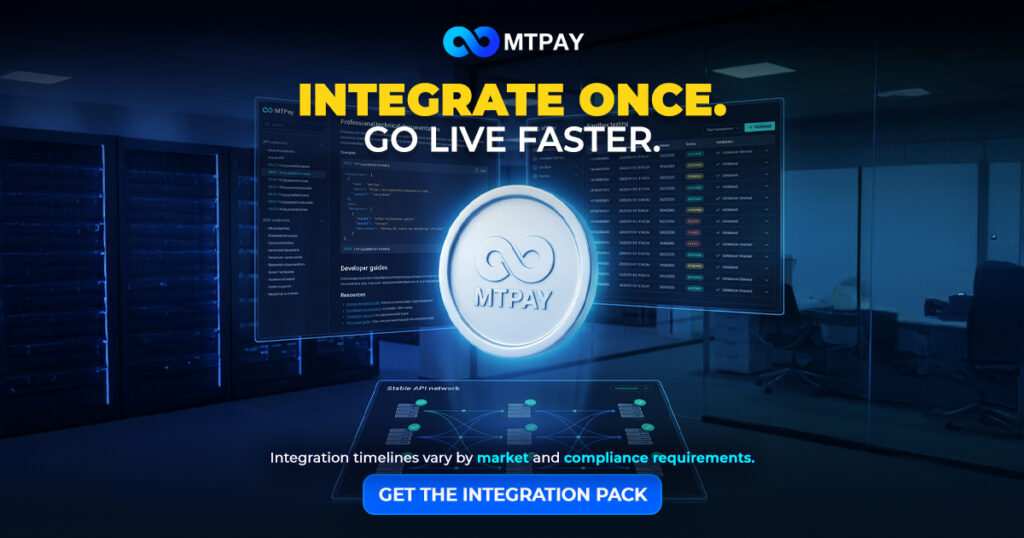
Launch speed is not a marketing promise. It is a technical outcome.
Too often, operators assume payment go-live delays are caused by external approvals or internal inefficiency. However, in practice, most delays originate from structural integration gaps: unclear API specifications, inconsistent callback behavior, sandbox environments that behave differently from production, and fragmented communication between tech, operations, and finance teams.
Therefore, the real competitive advantage is not just offering a gateway — it is delivering an operationally complete integration layer.
This is precisely where MTPAY positions itself differently.
First and foremost, unclear specifications are the primary source of integration drag.
When parameters change mid-build, when response formats are ambiguous, or when edge cases are undocumented, development teams are forced into repetitive clarification cycles. As a result, timelines extend, QA becomes reactive, and deployment confidence weakens.
In contrast, MTPAY approaches integration from an infrastructure-first mindset:
Because of this structured framework, engineering teams build once — not repeatedly. Consequently, implementation becomes linear rather than iterative chaos.
In short, cleaner documentation directly translates into shorter integration cycles.
Secondly, many payment projects slip at the testing stage.
A sandbox that behaves differently from production creates false confidence. Transactions pass in testing but fail after deployment. Webhook logic changes under real traffic. Settlement data formats shift unexpectedly.
When this happens, operators are forced into emergency patches during what should be a launch window.
MTPAY addresses this structural risk by providing a test environment that mirrors production behavior. That means:
As a result, when a merchant moves from sandbox to live, there are no behavioral surprises. The go-live phase becomes a controlled activation rather than a reactive debugging exercise.
Therefore, launch speed improves not because teams rush — but because environments are aligned from the beginning.
Finally, integration does not end at successful deposits.
True operational readiness requires alignment between transaction reporting, settlement summaries, and finance reconciliation processes. When callbacks are inconsistent or reporting structures lack clarity, internal teams must manually validate data across systems. Inevitably, this introduces delays and unnecessary friction.
MTPAY’s gateway layer is built with operational completeness in mind:
Consequently, tech, operations, and finance teams work from a unified data structure. Fewer handoffs are required. Dispute resolution becomes faster. And daily reporting aligns naturally with accounting needs.
In other words, integration quality directly impacts post-launch efficiency — not just launch timing.
Payment gateways do not delay projects randomly. They slip for predictable reasons:
Therefore, faster go-live does not come from pressure — it comes from structural clarity.
MTPAY supports merchants and operators with an integration-first gateway layer designed to reduce friction from build to deployment. Through clean API documentation, production-mirrored testing environments, stable webhook logic, and reconciliation-ready reporting, it transforms payment integration into a controlled, efficient process.
Ultimately, speed is not about rushing to market. It is about building on infrastructure that is ready to ship.
Read more: Fix Payment Visibility, Reduce Disputes: MTPAY Makes It Simple
Contact us:
https://t.me/mandy_xypher


150% Live Casino Welcome Bonus – Welcome To Nova88! Make your first deposit & get up to MYR128 Bonus Now! (New Member Only)