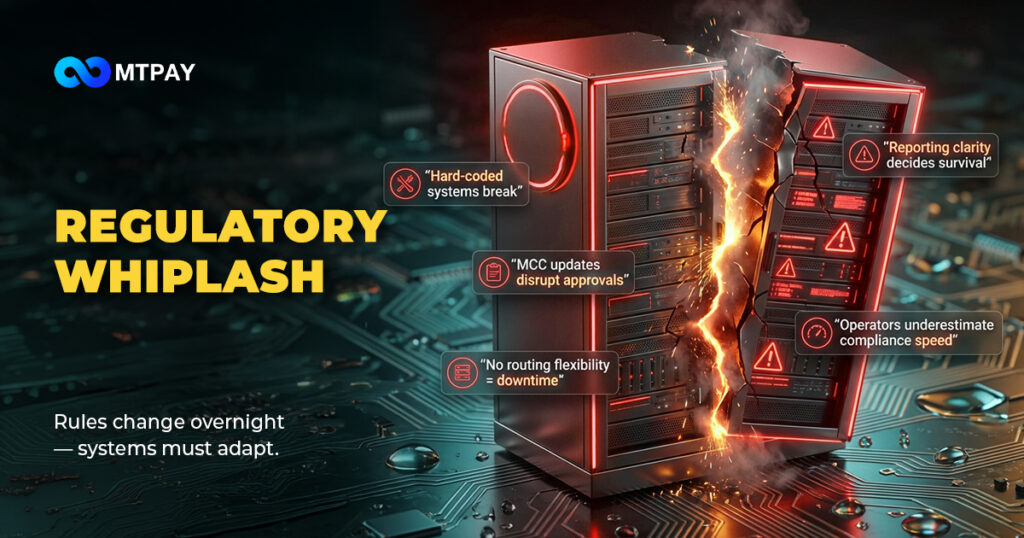
MCC updates can crush approvals, hard-coded stacks can’t adapt, and no routing flexibility means downtime. In fast-moving markets, reporting speed decides survival.

MCC updates can crush approvals, hard-coded stacks can’t adapt, and no routing flexibility means downtime. In fast-moving markets, reporting speed decides survival.

Regulation doesn’t move slowly anymore.
Banks update rules without notice. Card networks adjust risk logic mid-cycle. Local regulators reinterpret the same policy differently depending on pressure, headlines, or politics. What worked last month can fail tomorrow.
Most operators aren’t underestimating compliance itself. They’re underestimating speed. Regulatory whiplash isn’t about bad rules. It’s about systems that can’t adapt fast enough.
Many payment stacks are built for stability, not change. Logic is hard-coded. Flows are rigid. Any regulatory adjustment requires engineering time, approvals, redeployments.
That delay is fatal.
When rules change overnight, hard-coded systems don’t bend—they snap. Transactions fail, approvals drop, and operators lose revenue before anyone even understands why.
Merchant Category Codes sound boring until they change.
When MCC definitions or risk treatment updates roll out:
If your system can’t adapt routing or reporting around MCC changes, approvals drop with no obvious error. To the operator, it looks like “market slowdown.” In reality, it’s regulatory friction.
Regulatory pressure rarely shuts everything down at once. It hits specific routes, specific banks, or specific transaction types.
Systems without routing flexibility have only two states: live or dead.
If one route is blocked and there’s no alternative path, the entire flow goes offline. No fallback. No isolation. Just downtime.
Flexible routing isn’t optimization—it’s survival.
When regulators or banks ask questions, speed and clarity matter more than excuses.
Operators who survive can show:
Those who can’t produce reports fast enough don’t get time to fix it. They get restricted.
In regulatory environments, reporting is not documentation—it’s defense.
Most operators plan for compliance as a checklist.
What they miss is velocity.
Rules don’t change quarterly anymore. They change suddenly, locally, and without coordination. Systems designed for “eventual compliance” lose to systems designed for immediate adaptation.
MTPAY is built with regulatory volatility as a baseline assumption, not an edge case.
That means:
Not because regulation is predictable—but because it isn’t.
Regulatory whiplash isn’t coming. It’s already here.
The question isn’t whether rules will change. It’s whether your payment system can change faster than the restriction hits.
Systems that adapt stay live.
Systems that don’t get shut down.
That gap is where operators win or disappear.
Read more: Fake T+0 Settlement Exposed: What Real Providers Do
Contact Us:
https://t.me/mandy_xypher


150% Live Casino Welcome Bonus – Welcome To Nova88! Make your first deposit & get up to MYR128 Bonus Now! (New Member Only)